Generative AI Fundamentals: The Complete Guide to Foundation Models and Creative Intelligence
Sep 7, 2025 • —
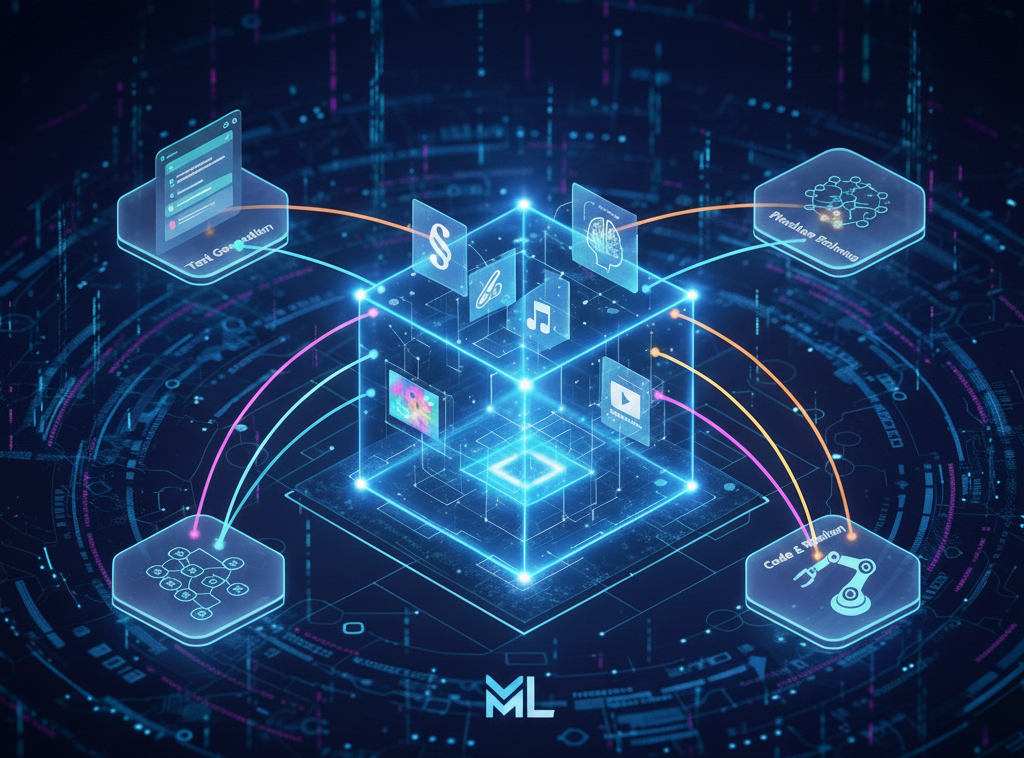
Generative AI Fundamentals: The Complete Guide to Foundation Models and Creative Intelligence
Posted on Sep 7, 2025 • 10 min read
tl;dr: ML
Generative AI Fundamentals: The Complete Guide to Foundation Models and Creative Intelligence
Generative AI has captured the world’s imagination, transforming how we create content, solve problems, and interact with technology. From ChatGPT’s conversational abilities to DALL-E’s stunning image generation, these systems represent a fundamental shift in artificial intelligence capabilities. But what exactly is generative AI, and why has it emerged as such a powerful force now?
What is Generative AI?
Generative AI refers to artificial intelligence systems that can create new content – whether text, images, code, audio, or video – that resembles human-created content. Unlike traditional AI systems that classify or analyze existing data, generative AI produces entirely new outputs based on patterns learned from training data.
The key distinction lies in the word “generative.” These systems don’t just recognize patterns; they use those patterns to generate novel, creative outputs that didn’t exist before.
Why Now? The Perfect Storm for Generative AI
Machine learning has existed for decades, so what has led to the emergence of generative AI right now? The answer lies in a convergence of factors:
Massive Resource Investment: Companies and research institutions have made unprecedented investments in:
- Large, specialized teams of researchers and engineers
- Enormous computational resources and infrastructure
- The willingness to pursue ambitious, long-term projects
Technological Breakthroughs: Key innovations have converged:
- Transformer architecture revolutionizing how models process sequential data
- Advances in training techniques and optimization methods
- Improved hardware, particularly GPUs designed for parallel processing
Data Abundance: The internet provides vast amounts of training data:
- Billions of text documents, images, and multimedia content
- Diverse, multilingual datasets spanning virtually every domain
- Continuous generation of new content to train on
Computational Power: Modern infrastructure enables:
- Training models with billions or trillions of parameters
- Distributed computing across thousands of machines
- Cloud platforms making powerful resources accessible
Foundation Models: The Backbone of Generative AI
Generative AI is powered by foundation models (FMs) – large-scale models pretrained on internet-scale data. These models represent a paradigm shift from traditional machine learning approaches.
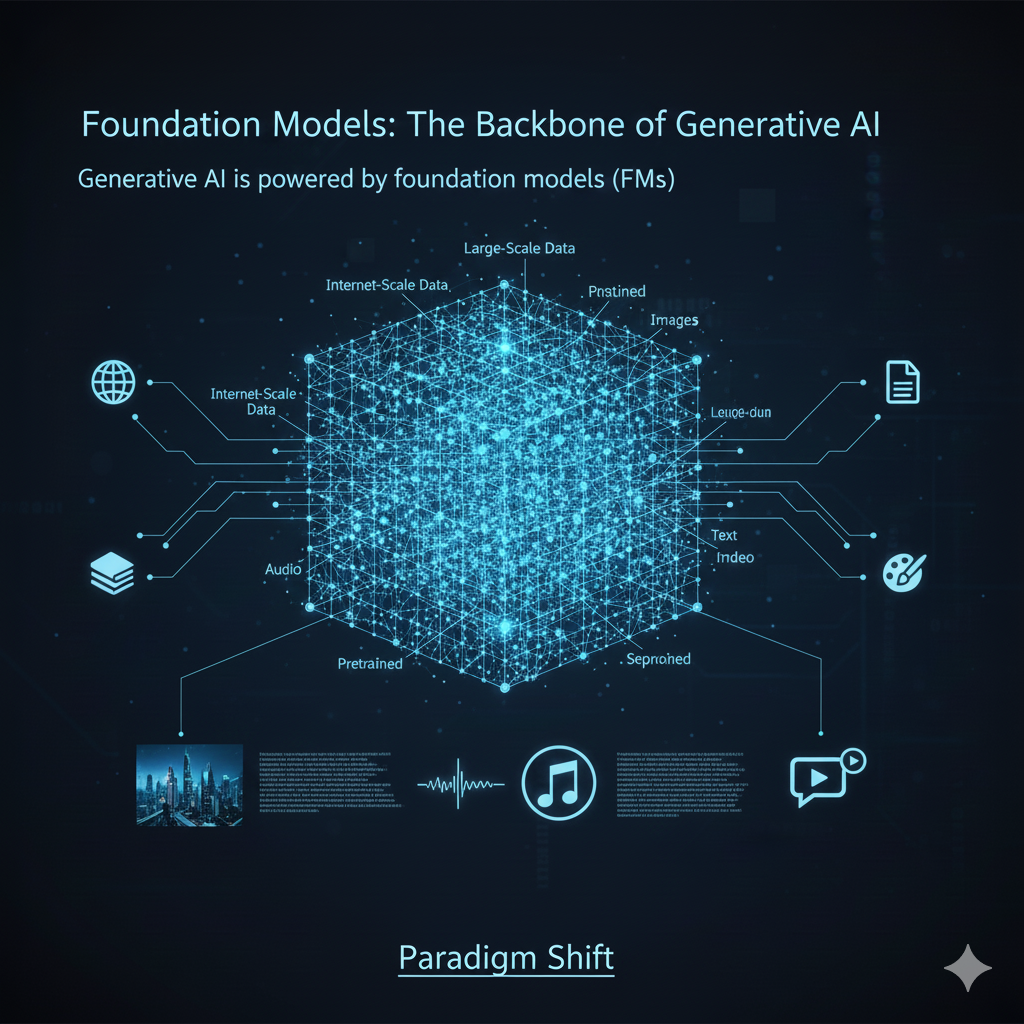
Traditional ML vs. Foundation Models
Traditional Approach:
- Train separate models for each specific task
- Require labeled data for each application
- Limited to narrow, predefined functions
- Expensive and time-consuming to develop
Foundation Model Approach:
- Single model adapted for multiple tasks
- Leverages unlabeled data at massive scale
- Versatile across diverse applications
- Efficient transfer learning to new domains
The Foundation Model Lifecycle
The development of foundation models follows a comprehensive process:
1. Data Selection
Foundation models require training on massive datasets from diverse sources. Unlike traditional ML, they can use unlabeled data at scale, which is much easier to obtain than labeled data. This includes:
- Raw text from websites, books, and articles
- Images from across the internet
- Audio and video content
- Code repositories and documentation
The key is diversity – models need exposure to various domains, languages, styles, and formats to develop robust understanding.
2. Pre-training
Foundation models are typically pre-trained through self-supervised learning, where labeled examples aren’t required. The model learns by predicting parts of the input data from other parts.
Initial Pre-training: The model learns fundamental patterns:
- Language structure and grammar
- Semantic relationships between words
- Context and meaning (e.g., “drink” as beverage vs. action)
- Common sense reasoning
Continuous Pre-training: Models can be further trained on additional data to:
- Expand knowledge base
- Improve understanding of specific domains
- Stay current with new information
- Enhance generalization capabilities
3. Optimization
Pre-trained models can be optimized through various techniques:
- Prompt Engineering: Crafting better instructions
- Fine-tuning: Training on task-specific data
- Retrieval-Augmented Generation (RAG): Adding external knowledge
- Constitutional AI: Aligning with human values
4. Evaluation
Performance assessment involves:
- Benchmark testing on standardized datasets
- Human evaluation of output quality
- Safety and bias testing
- Business metric alignment
5. Deployment
Integration into production systems:
- API development for applications
- Real-time inference optimization
- Scalability and reliability engineering
- User interface design
6. Feedback and Continuous Improvement
Ongoing enhancement through:
- User feedback collection
- Performance monitoring
- Bias detection and mitigation
- Iterative model updates
Types of Foundation Models
Large Language Models (LLMs)
Large Language Models are the most visible type of foundation model, powering applications like ChatGPT, Claude, and GPT-4. Most modern LLMs are based on the transformer architecture.
How LLMs Work
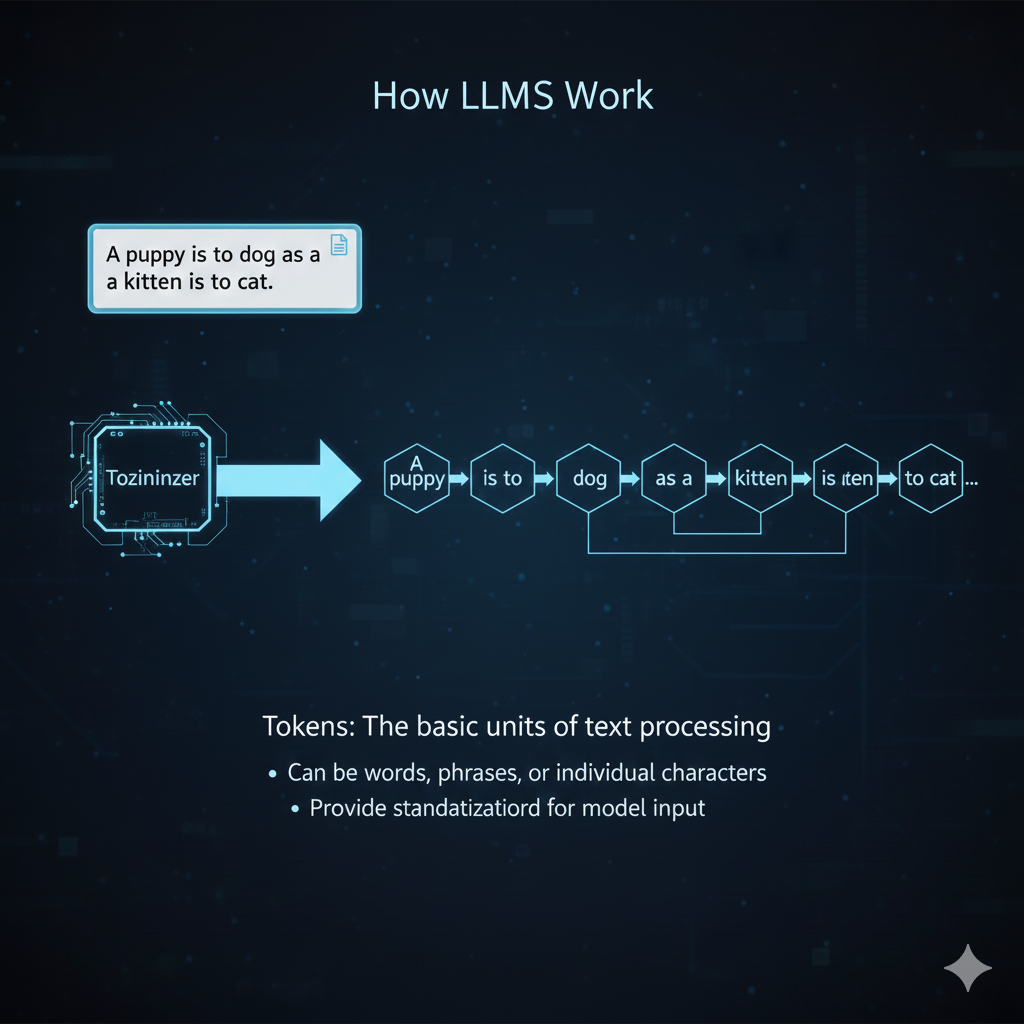
Tokens: The basic units of text processing
- Can be words, phrases, or individual characters
- Provide standardization for model input
- Example: “A” “puppy” “is” “to” “dog” “as” “a” “kitten” “is” “to”“cat.”
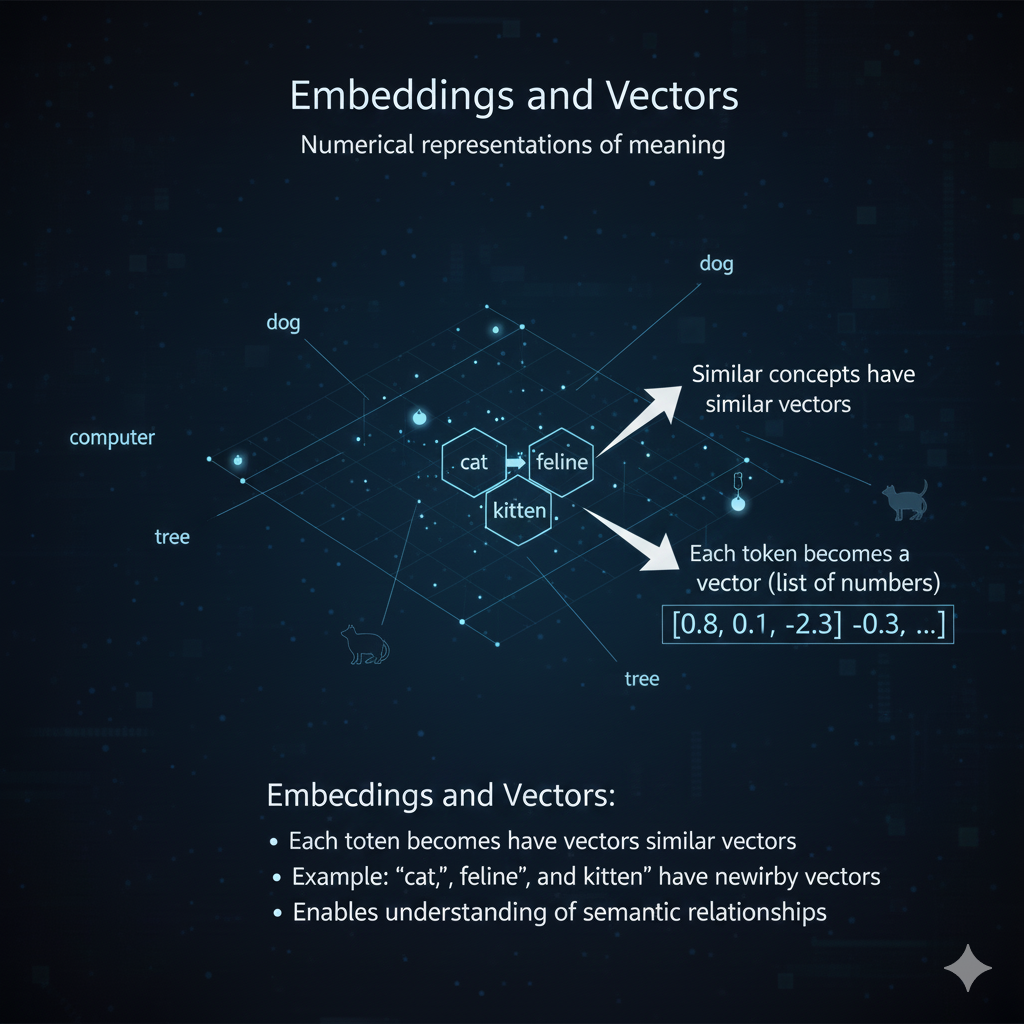
Embeddings and Vectors: Numerical representations of meaning
- Each token becomes a vector (list of numbers)
- Similar concepts have similar vectors
- Example: “cat,” “feline,” and “kitten” have nearby vectors
- Enables understanding of semantic relationships
Attention Mechanisms: How models focus on relevant information
- Determine which parts of input are most important
- Enable understanding of context and dependencies
- Allow processing of long sequences effectively
LLM Capabilities
- Text Generation: Creating coherent, contextually appropriate text
- Question Answering: Understanding and responding to queries
- Summarization: Condensing long documents into key points
- Translation: Converting between languages
- Code Generation: Writing and debugging programming code
- Creative Writing: Producing stories, poems, and scripts
Diffusion Models
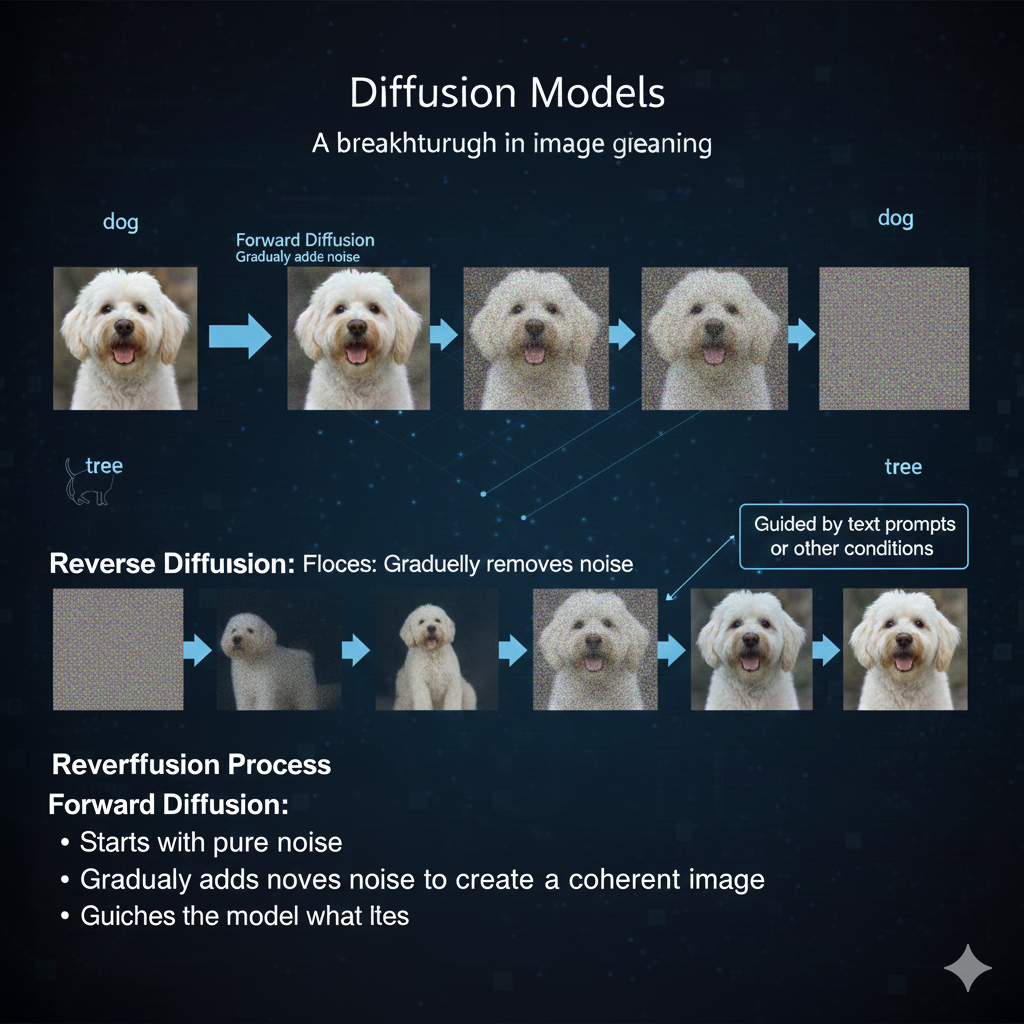
Diffusion models represent a breakthrough in image generation, powering tools like DALL-E, Midjourney, and Stable Diffusion.
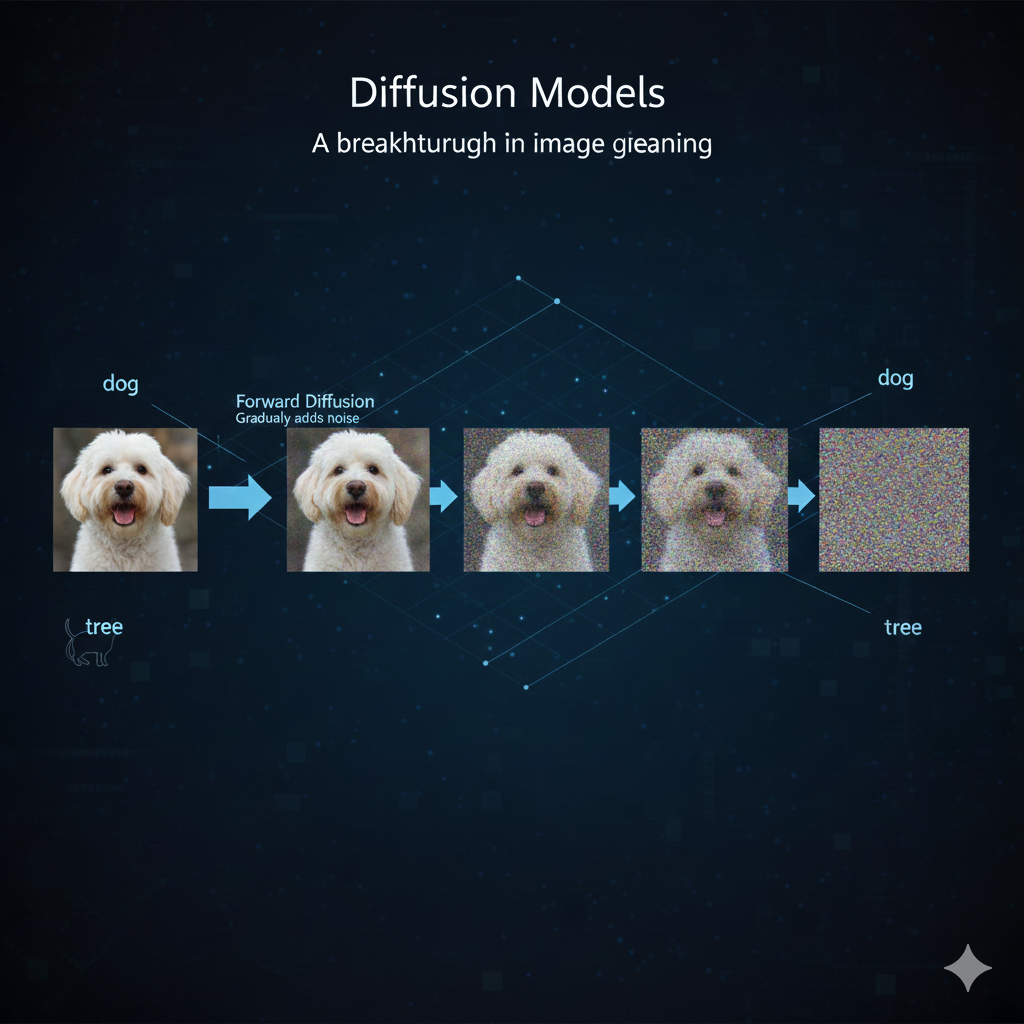
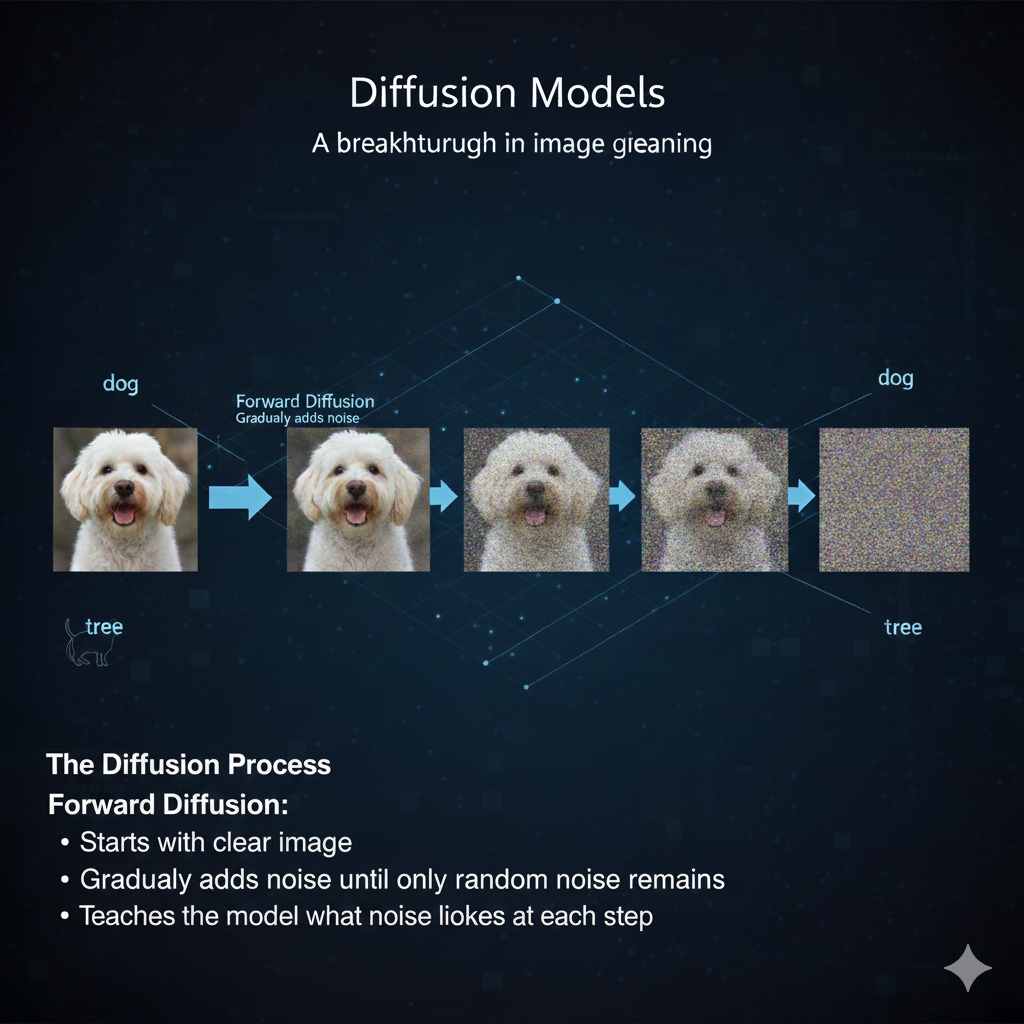
The Diffusion Process
Forward Diffusion:
- Starts with a clear image
- Gradually adds noise until only random noise remains
- Teaches the model what noise looks like at each step
Reverse Diffusion:
- Starts with pure noise
- Gradually removes noise to create a coherent image
- Guided by text prompts or other conditions
Applications Beyond Images
- Video Generation: Creating short video clips
- Audio Synthesis: Generating music and sound effects
- 3D Model Creation: Producing three-dimensional objects
- Medical Imaging: Enhancing or generating medical scans
Multimodal Models
Multimodal models can process and generate multiple types of data simultaneously, representing the next frontier in AI capabilities.
Capabilities
- Vision-Language Understanding: Describing images or answering questions about visual content
- Text-to-Image Generation: Creating images from text descriptions
- Image-to-Text: Generating captions or descriptions from images
- Cross-Modal Reasoning: Understanding relationships between different data types
Applications
- Automated Content Creation: Generating marketing materials with text and images
- Educational Tools: Creating interactive learning materials
- Accessibility: Describing visual content for visually impaired users
- Scientific Research: Analyzing complex data across modalities
Other Generative Models
Generative Adversarial Networks (GANs)
GANs use two neural networks in competition:
- Generator: Creates synthetic data *Discriminator: Distinguishes real from fake data *Through adversarial training, the generator improves until it can fool the discriminator
Applications:
- High-quality image generation
- Data augmentation for training
- Style transfer and image editing
- Deepfake technology (with ethical concerns)
Variational Autoencoders (VAEs)
VAEs combine autoencoders with probabilistic modeling:
- Encoder: Compresses input into latent space
- Decoder: Reconstructs output from latent representation
- Enables controlled generation by sampling from latent space
Applications:
- Anomaly detection
- Data compression
- Drug discovery
- Generating variations of existing content
Optimizing Foundation Model Outputs
Prompt Engineering
Prompt engineering is the art and science of crafting effective instructions for foundation models. It’s the fastest and most cost-effective way to improve model performance.
Components of Effective Prompts
Instructions: Clear task descriptions
- “Summarize the following article in 3 sentences”
- “Translate this text from English to Spanish”
- “Generate a creative story about…”
Context: External information to guide the model
- Background information
- Relevant examples
- Specific requirements or constraints
Input Data: The content to be processed
- Text to summarize
- Questions to answer
- Images to describe
Output Indicators: Desired format specifications
- “Respond in bullet points”
- “Use a formal tone”
- “Include citations”
Advanced Prompting Techniques
Few-Shot Learning: Providing examples in the prompt
- Shows the model the desired input-output pattern
- Improves performance on specific tasks
- Reduces need for fine-tuning
Chain-of-Thought: Encouraging step-by-step reasoning
- “Let’s think about this step by step”
- Improves performance on complex problems
- Makes reasoning more transparent
Role-Playing: Asking the model to adopt a specific persona
- “You are an expert financial advisor”
- “Act as a creative writing teacher”
- Improves response quality and consistency
Fine-tuning
Fine-tuning involves training a pre-trained model on specific, smaller datasets to improve performance on particular tasks.
Types of Fine-tuning
Instruction Fine-tuning:
- Uses examples of desired input-output behavior
- Teaches the model to follow specific instructions
- Improves consistency and reliability
Reinforcement Learning from Human Feedback (RLHF):
- Incorporates human preferences into training
- Aligns model behavior with human values
- Reduces harmful or biased outputs
When to Fine-tune
Consider fine-tuning when:
- You need domain-specific knowledge (medical, legal, technical)
- The task requires consistent formatting or style
- You have sufficient quality training data
- Generic models don’t meet performance requirements
Retrieval-Augmented Generation (RAG)
RAG combines the power of foundation models with external knowledge sources, providing a way to keep models current and accurate.
How RAG Works
- Query Processing: User question is analyzed
- Document Retrieval: Relevant documents are found in a knowledge base
- Context Integration: Retrieved information is added to the prompt
- Response Generation: Model generates answer using both its training and retrieved context
Advantages of RAG
- Up-to-date Information: Access to current data beyond training cutoff
- Factual Accuracy: Grounding responses in verified sources
- Transparency: Clear sources for generated information
- Cost-Effective: No need to retrain models for new information
RAG vs. Fine-tuning
RAG:
- Doesn’t change model weights
- Easy to update knowledge base
- Maintains model generalization
- Lower computational cost
Fine-tuning:
- Modifies model parameters
- Better integration of domain knowledge
- Requires retraining for updates
- Higher computational cost
Applications and Use Cases
Content Creation
Writing and Editing:
- Blog posts and articles
- Marketing copy and advertisements
- Technical documentation
- Creative writing and storytelling
Visual Content:
- Social media graphics
- Product mockups and prototypes
- Artistic illustrations
- Logo and brand design
Business Applications
Customer Service:
- Chatbots and virtual assistants
- Automated response generation
- Sentiment analysis and routing
- Multilingual support
Analytics and Insights:
- Report generation and summarization
- Data visualization narratives
- Market research synthesis
- Trend analysis and forecasting
Education and Research
Personalized Learning:
- Adaptive content generation
- Interactive tutoring systems
- Assessment and feedback
- Curriculum development
Research Assistance:
- Literature review automation
- Hypothesis generation
- Data analysis and interpretation
- Scientific writing support
Creative Industries
Entertainment:
- Game content generation
- Music composition and production
- Video and animation creation
- Interactive storytelling
Design and Architecture:
- Conceptual design exploration
- Architectural visualization
- Product design iteration
- Brand identity development
Challenges and Considerations
Technical Challenges
Computational Requirements:
- Massive infrastructure needs
- High energy consumption
- Expensive training and inference
- Scalability limitations
Quality Control:
- Ensuring output accuracy
- Maintaining consistency
- Preventing harmful content
- Managing model drift
Ethical and Social Considerations
Bias and Fairness:
- Training data biases
- Representation issues
- Discriminatory outputs
- Fairness across demographics
Misinformation and Deepfakes:
- Potential for false information
- Sophisticated fake content
- Verification challenges
- Trust and credibility issues
Privacy and Security:
- Data protection concerns
- Model extraction attacks
- Prompt injection vulnerabilities
- Intellectual property issues
Economic and Workforce Impact
Job Displacement:
- Automation of creative tasks
- Changing skill requirements
- Need for workforce retraining
- Economic transition challenges
Market Concentration:
- High barriers to entry
- Dominance of large tech companies
- Access and equity issues
- Regulatory challenges
The Future of Generative AI
Emerging Trends
Multimodal Integration:
- Seamless cross-modal generation
- Unified understanding systems
- Enhanced user interfaces
- Immersive experiences
Personalization:
- Individual model fine-tuning
- Personalized AI assistants
- Context-aware systems
- Adaptive learning
Efficiency Improvements:
- Smaller, more efficient models
- Edge computing deployment
- Reduced computational requirements
- Sustainable AI development
Potential Breakthroughs
Reasoning and Planning:
- Advanced logical reasoning
- Long-term planning capabilities
- Causal understanding
- Scientific discovery
Embodied AI:
- Physical world interaction
- Robotics integration
- Real-time adaptation
- Sensorimotor learning
Getting Started with Generative AI
For Individuals
- Explore Available Tools:
- ChatGPT, Claude, and other LLMs
- Image generators like DALL-E or Midjourney
- Code assistants like GitHub Copilot
- Specialized applications for your field
- Learn Prompt Engineering:
- Practice crafting effective prompts
- Experiment with different techniques
- Study successful prompt patterns
- Join communities and forums
- Understand Limitations:
- Recognize when AI outputs may be inaccurate
- Verify important information
- Understand bias and ethical considerations
- Develop critical evaluation skills
For Organizations
- Assess Use Cases:
- Identify high-value applications
- Evaluate ROI potential
- Consider ethical implications
- Plan for integration challenges
- Build Capabilities:
- Invest in technical infrastructure
- Develop in-house expertise
- Partner with AI providers
- Create governance frameworks
- Pilot and Scale:
- Start with low-risk applications
- Measure performance and impact
- Iterate based on feedback
- Gradually expand deployment
Key Takeaways
Generative AI represents a transformative technology that’s reshaping how we create, work, and interact with information. Key points to remember:
- Foundation Models: Large-scale, versatile models that can be adapted for multiple tasks
- Multiple Modalities: Text, images, audio, video, and code generation capabilities
- Optimization Techniques: Prompt engineering, fine-tuning, and RAG for improved performance
- Broad Applications: From content creation to scientific research to business automation
- Ongoing Challenges: Technical limitations, ethical concerns, and societal implications
- Rapid Evolution: Fast-paced development with frequent breakthroughs and improvements
The field of generative AI is still in its early stages, with enormous potential for continued innovation and impact. Whether you’re an individual looking to enhance your productivity or an organization seeking competitive advantage, understanding these fundamentals will help you navigate the exciting world of generative AI.
Success in this field requires balancing technical understanding with ethical responsibility, creative exploration with critical evaluation, and ambitious vision with practical implementation. As generative AI continues to evolve, those who understand its capabilities and limitations will be best positioned to harness its transformative power responsibly and effectively.